
“We changed the paint, but the problem came back.”
That is the kind of situation coating teams do not want to see twice.
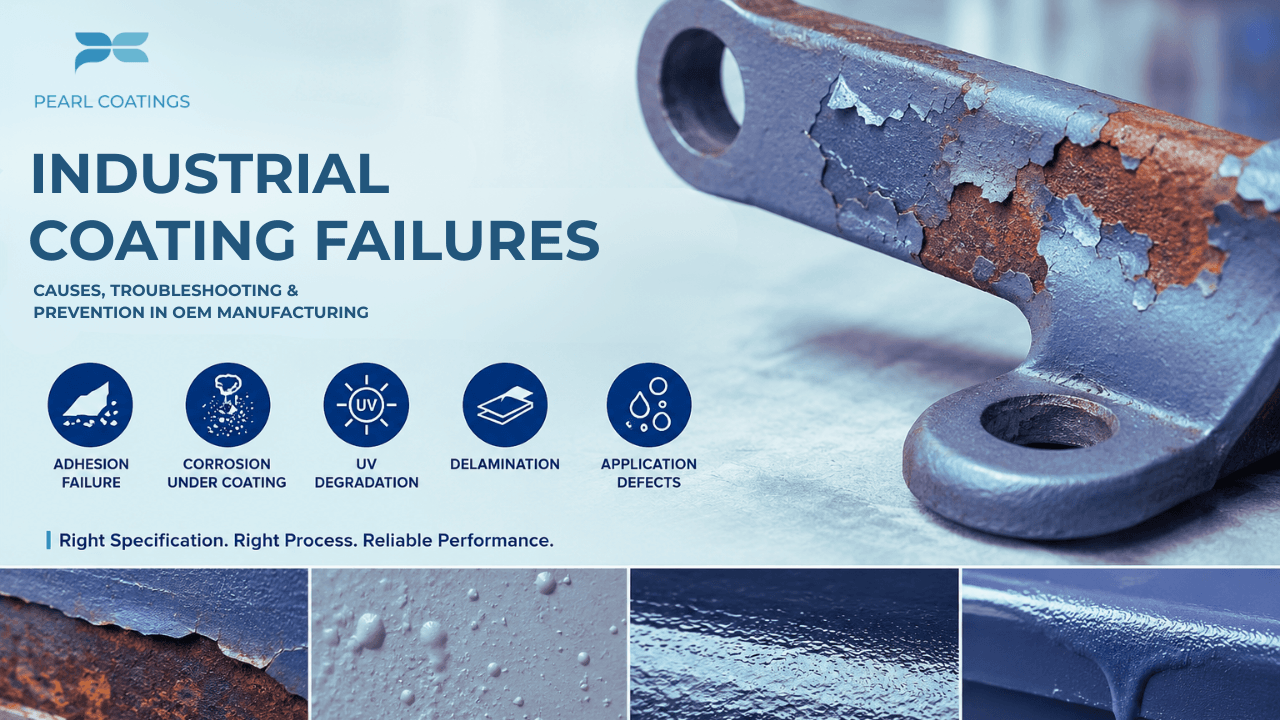
A coating failure can show up as peeling, blistering, corrosion, poor gloss, orange peel or other surface defects. The visible problem is easy to spot. Finding the reason behind it can take much longer.
In an OEM production environment, the cause can sit anywhere in the process. It could be surface preparation, primer selection, DFT, application conditions, curing, recoat timing, or compatibility between coating layers.
That is why the first step should be finding out why the coating failed.
Before changing the coating, the entire process needs to be checked. What was specified? How was the substrate prepared? Was the right coating system used? Was it applied within the recommended conditions? Was the required DFT achieved?
These questions usually tell you more about a coating failure than simply looking at the failed surface.
If you are reviewing your coating requirements, start by going back to our complete OEM buyer’s guide.
Where do industrial coating failures usually occur?
Most coating failures seen in OEM manufacturing can be grouped into five areas:
- Adhesion failure, where the coating peels, flakes, or loses its bond.
- Corrosion under the coating, where moisture reaches the substrate and corrosion spreads beneath the film.
- UV degradation, which can cause chalking, fading and loss of gloss.
- Delamination, where coating layers separate from each other or from the substrate.
- Application defects, such as orange peel, sagging, pinholes and fish-eyes
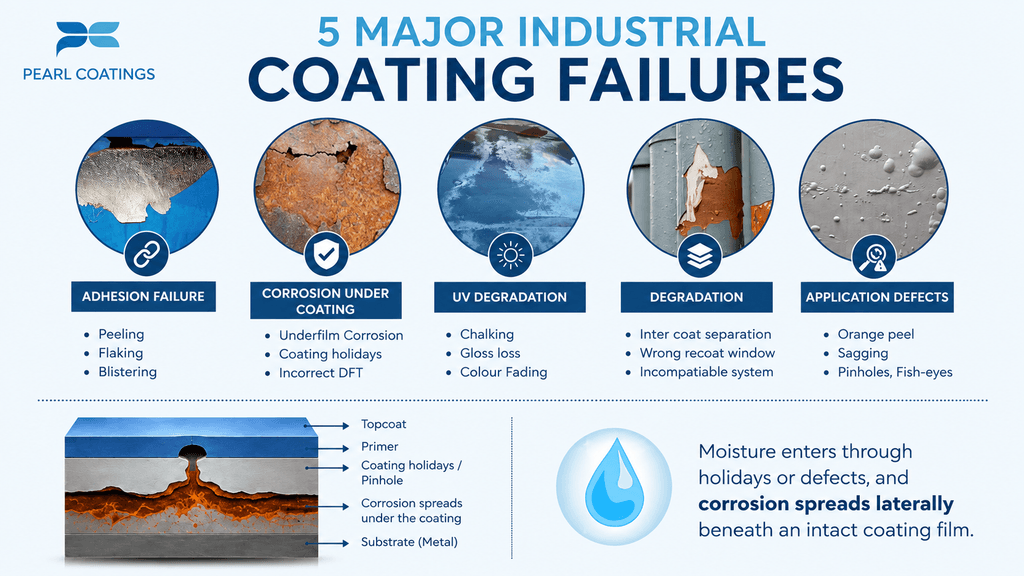
These failures do not always point to a problem with the coating itself. Surface preparation, primer selection, application conditions, DFT, curing and compatibility all need to be considered before reaching that conclusion.
Adhesion failure
Peeling, flaking and blistering are common signs of adhesion failure. The coating may separate from the substrate, or one coating layer may separate from another. Poor surface preparation is one of the first things to check because oil, grease, dust, rust and moisture can prevent proper bonding. Incorrect primer selection, incorrect mixing, unsuitable temperature or humidity and applying the next coat outside the recommended recoat window can also affect adhesion.
Before changing the coating, check the substrate preparation, primer, application conditions and curing process. Pearl’s existing guide on what causes paint adhesion failure covers these causes in more detail.
Corrosion under coating
Corrosion under a coating starts when moisture reaches the substrate. A scratch, pinhole or coating holiday can expose the metal and allow corrosion to spread beneath the coating. Poor surface preparation, insufficient dry film thickness (DFT), incorrect primer selection and an unsuitable coating system can increase the risk.
The service environment also needs to be considered before selecting the coating system. A system suitable for a dry indoor application may not provide enough protection in a coastal or industrial environment.
Choosing the right corrosion category
ISO 12944 classifies atmospheric corrosivity from C1 through C5, with CX covering extreme environments. The required coating system depends on the corrosivity category, expected service life and exposure conditions. Pearl’s guide on ISO 12944 corrosion categories explains the C1 to C5 classifications in more detail.
DFT is equally important. If the coating is applied below the specified thickness, corrosion protection can suffer. Excessive film build can also create problems such as sagging, cracking and poor curing.
Salt spray testing
Salt spray testing is commonly used to assess the corrosion resistance of coatings under controlled conditions. ISO 9227 covers neutral salt spray, acetic acid salt spray and copper-accelerated acetic acid salt spray tests. Q-Lab’s guide to ISO 9227 salt spray testing explains the test and its applications.
Salt spray hours should not be treated as a direct prediction of outdoor service life. Actual performance also depends on surface preparation, DFT, coating system, exposure and maintenance.
UV degradation
Outdoor coatings have to withstand prolonged sunlight as well as moisture and temperature changes. UV exposure can cause chalking, gloss loss and colour fading. This becomes particularly important for OEM components where appearance is part of the specification.
Epoxy is widely used for corrosion protection, but conventional epoxy is generally not the preferred final outdoor finish where long-term colour and gloss retention are required. A suitable polyurethane topcoat can provide better UV and weather resistance. Pearl’s epoxy coatings and polyurethane coatings can be used as part of a coating system depending on the application.
The coating system should therefore be selected according to the actual exposure and the required finish.
Delamination
Delamination occurs when one coating layer separates from another or from the substrate. Common causes include contamination between coats, an incorrect recoat window, excessive film build, poor inter-coat adhesion, incorrect curing, and incompatible primer and topcoat combinations.
When investigating delamination, check the complete coating system rather than replacing only one product. The primer needs to be suitable for the substrate and compatible with the coating applied over it.
Application defects
Application defects often provide clues about what went wrong during the coating process.
- Orange peel gives the surface a rough, uneven appearance and can result from poor atomisation, incorrect viscosity or unsuitable spray settings.
- Sagging occurs when the wet coating runs down the surface before it dries. Excessive film build, low viscosity and slow drying can contribute to it.
- Pinholes are small openings in the coating film. They can result from trapped air, porous substrates, contamination, or excessive film build. If they reach the substrate, they can create a path for moisture and lead to corrosion.
- Fish-eyes appear as small circular craters in the coating. They are commonly associated with contamination from oil, grease, silicone, or other surface contaminants.
The first checks should be surface preparation, coating viscosity, spray equipment, application settings, drying conditions and film thickness.
Common specification mistakes that lead to coating failure
Some coating failures begin before the first coat is applied.
Choosing a coating only because it costs less can create higher costs through rework, rejection or premature maintenance. Ignoring substrate preparation can affect adhesion and corrosion protection. Mixing products from different manufacturers without checking compatibility can cause problems between coating layers. Selecting the wrong primer can leave the substrate under-protected. Skipping DFT verification makes it difficult to know whether the coating has been applied within the required range.
A good coating specification should define the substrate, surface preparation, coating system, primer, application method, DFT, curing conditions and service environment.
Testing requirements also vary by coating and application. If you are deciding which coating type to specify for your application, Pearl’s coating
technology guide covers its epoxy, polyurethane, primer and other coating systems.
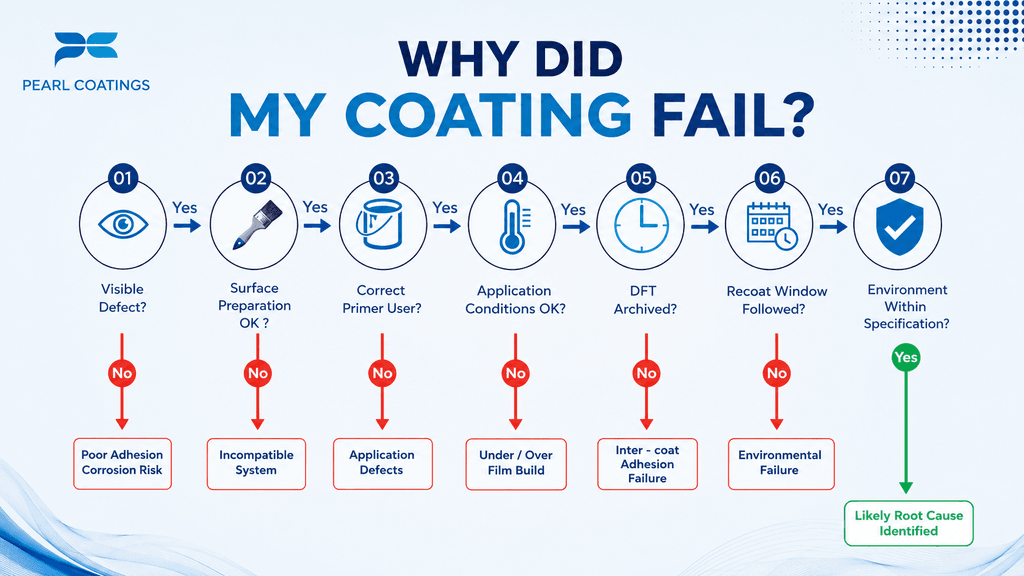
Troubleshooting before blaming the coating
When a coating fails, changing the product should not be the first response. Start by checking the process that produced the failure.
- Check the substrate
Was the surface cleaned and prepared to the required standard? Look for oil, grease, dust, rust, moisture or other contamination. - Check the primer
Was the correct primer selected for the substrate and service environment? Is it compatible with the topcoat? - Check the DFT
Was dry film thickness measured after application? Check whether it falls within the specified minimum and maximum range. - Check application conditions
Was the coating applied within the recommended temperature and humidity range? Were the substrate and surrounding conditions suitable for application? - Check the recoat window
Was the next coat applied within the specified time? Applying it too early or too late can affect inter-coat adhesion. - Check mixing and application
Was the correct mixing ratio used? Was the coating thinned correctly? Were the spray equipment, pressure, nozzle and application method suitable? - Check curing
Was the coating given enough time and the right conditions to cure? This is particularly important for two-component and stoving systems. - Check the complete coating system
Were the primer, intermediate coat and topcoat compatible? Was the system suitable for the actual service environment?
This process helps identify whether the failure came from the coating itself or from specification, preparation or application.
How to prevent industrial coating failures
Coating failure prevention starts with the specification.
Before selecting a coating, understand the substrate, service environment and application process. Define the required surface preparation, coating system, DFT, and curing conditions. Make sure the primer and topcoat are compatible and verify the application process before production begins.
The aim is not simply to select a coating that passes a test. The coating system needs to perform under the conditions in which the finished component will actually be used.
India’s automotive OEM coatings market was valued at $959.8 million, with a projected CAGR of 6%, according to Verified Market Research. As OEM production grows, consistent coating performance becomes increasingly important because failures can lead to rejection, rework and production delays.
If your team is dealing with repeated coating failures, corrosion, adhesion problems or application defects, contact Pearl Coating to discuss the coating system and application.
You can also go back to our complete OEM buyer’s guide.
Frequently Asked Questions
1. What is the most common industrial coating failure?
Adhesion failure is one of the common problems seen in industrial coating applications. Peeling, flaking and blistering can indicate poor adhesion to the substrate or between coating layers.
2. What causes paint adhesion failure?
Poor surface preparation, moisture, contamination, incorrect primer selection, incompatible products, incorrect mixing and unsuitable application conditions can contribute to adhesion failure.
3. What causes corrosion under paint?
Corrosion can develop when moisture reaches the substrate through scratches, pinholes, coating holidays or weak areas in the coating. Poor surface preparation, low DFT and an unsuitable coating system can increase the risk.
4. Why does epoxy coating chalk outdoors?
Conventional epoxy can lose gloss and colour after prolonged UV exposure. For outdoor applications where colour and gloss retention matter, epoxy is commonly used with a suitable polyurethane topcoat.
5. What is coating delamination?
Delamination is the separation of a coating from the substrate or from another coating layer. Poor inter-coat adhesion, contamination, incorrect recoat timing, and incompatible products can cause it.
6. How can industrial coating failures be prevented?
Start with the correct specification. Prepare the substrate properly, select a compatible coating system, control application conditions, measure DFT, and follow the specified curing and recoat conditions.
7. Why is dry film thickness (DFT) important?
DFT affects coating performance. Low DFT can reduce corrosion protection, while excessive film build can cause sagging, cracking and curing problems.
8. Why should primer and topcoat come from the same manufacturer?
Using products from the same manufacturer can make compatibility easier to establish and gives the customer a single technical point of contact. Products from different manufacturers can also be used when the complete system has been tested and approved.